asokatechnologies@gmail.com 09347143789/09949240245

Search This Blog

Friday, 8 July 2022

Control Strategy Research of D-STATCOM Using Active Disturbance Rejection Control Based on Total Disturbance Error Compensation

ABSTRACT:

The distribution static synchronous compensator (D-STATCOM) has the characteristics of nonlinearity, multivariable and strong coupling. Based on the analysis of the D-STATCOM mathematical model, in order to improve the performance of the linear active disturbance rejection controller (LADRC), solve the coupling problem between the d-axis and q-axis current and improve the dynamic tracking response speed and anti-interference ability. A controller with LADRC that compensates the error of the total disturbance is proposed, and the stability of the improved first-order LADRC is proved by the Lyapunov stability theory. Then the output of the full interference channel is corrected to improve the anti-interference ability of the system and the interference observation ability of the linear extended state observer (LESO) to high frequency noise. Through the analysis of the Bode diagram in the frequency domain, compared with the traditional LADRC, the improved LADRC proposed in this paper has better anti-interference performance. Finally, the improved first-order LADRC is used to replace the traditional D-STATCOM control strategy for current inner loop control, which effectively reduces the disturbance observation error of LESO. The experimental results show that the improved LADRC control performance is better than the proportional integral (PI) controller, and it has better tracking performance and anti-interference performance.

KEYWORDS:

1.      Distribution static synchronous compensator (D-STATCOM)

2.      Total disturbance

3.       Linear active disturbance rejection control (LADRC)

4.      Linear extended state observer (LESO)

5.      Anti-interference performance.

SOFTWARE: MATLAB/SIMULINK

 CIRCUIT DIAGRAM:


Figure 1. Overall Control Structure Of Voltage Type D-Statcom Device.

 EXPECTED SIMULATION RESULTS:


Figure 2. Comparison Of Reactive Current Tracking Curves Under The Control Of Pi And Improved Ladrc Under Low Voltage Ride-Through.


Figure 3.Comparison Of Reactive Current Tracking Under Pi And Improved Ladrc Control With Increasing And Decreasing Load.


Figure 4. Comparison Of Reactive Power And Active Power Under The Control Of Pi And Improved Ladrc Under Low Voltage Ride-Through.


Figure  5. Comparison Of Reactive Power And Active Power Under Pi And Improved Ladrc Control With Increasing And Decreasing Load.


CONCLUSION:

 Aiming at the nonlinear, multivariable and strong coupling characteristics of D-STATCOM, this paper proposes an improved first-order LADRC for the internal current loop of the D-STATCOM system. The key to LADRC performance is whether the extended state observer can accurately estimate the state variables of the system. The innovation of this paper is to propose a linear active disturbance rejection controller that compensates the total disturbance error to improve the control performance of the entire control system. And through the rigorous mathematical derivation of the Lyapunov stability theory, the stability of the improved first-order LADRC is proved, and the asymptotic stability conditions are given. Then correct the output of the total disturbance channel. Finally, the experiment proved the correctness and feasibility of the improved first-order LADRC. In addition, this article only considers the situation of balanced load and symmetrical grid voltage failure. Future work will focus on the study of the D-STATCOM control method of the LADRC under unbalanced load and distorted grid voltage.

 REFERENCES:

 [1] H. Bakir and A. A. Kulaksiz, ``Modelling and voltage control of the solarwind hybrid micro-grid with optimized STATCOM using GA and BFA,'' Eng. Sci. Technol., Int. J., vol. 23, no. 3, pp. 576_584, Jun. 2020.

[2] S. R. Marjani, V. Talavat, and S. Galvani, ``Optimal allocation of DSTATCOM and recon_guration in radial distribution network using MOPSOalgorithm in TOPSIS framework,'' Int. Trans. Electr. Energy Syst., vol. 29, no. 2, p. e2723, 2019.

[3] S. Rezaeian-Marjani, S. Galvani, V. Talavat, and M. Farhadi-Kangarlu, ``Optimal allocation of D-STATCOM in distribution networks including correlated renewable energy sources,'' Int. J. Electr. Power Energy Syst., vol. 122, Nov. 2020, Art. no. 106178.

[4] R. O. de Sousa, A. F. Cupertino, L. M. F. Morais, and H. A. Pereira, ``Minimum voltage control for reliability improvement in modular multilevel cascade converters-based STATCOM,'' Microelectron. Rel., vol. 110, Jul. 2020, Art. no. 113693.

[5] W. Xiao, J. Li, and Y. Wang, ``Study on reactive power compensation strategy based on STATCOM,'' Power Capacitor Reactive Power Com- pensation, vol. 40, no. 6, pp. 24_29, 2019.


Control of switched reluctance generator in wind power system application for variable speeds

ABSTRACT:

Switched reluctance generators (SRGs) come into prominence in other electrical machines with its simple structure, only stator winding, reliability, high fault tolerance and the possibility of working within wide speed range. These generators are used especially in wind power plants due to their ability to operate in variable speed range and applications of aviation and electric cars. In this study, the control of the SRG was performed. A simulation of SRG driver in Matlab/Simulink was performed and the real-time implementation control of SRG is carried out on DS1103 Ace kit digital signal processor to determine the performance of the SRG. The output voltage of the SRG is controlled by the proportional-integral (PI) voltage controller. As a result, the graphs of change in SRG phases currents and SRG output voltage were obtained according to different parameters. Simulation results compared with experimental results. Consequently, they overlap on experimental results.

KEYWORDS:

1.      Switched reluctance generator

2.      Wind power system

 SOFTWARE: MATLAB/SIMULINK

 BLOCK DIAGRAM:


Fig. 1. (a) Block diagram of SRG based WECS, (b) Mechanical power curves of the

wind turbine system.

EXPECTED SIMULATION RESULTS:


Fig. 2. The graph of the SRG’s phase currents obtained by (a) simulation, (b)

experimental (n = 1000 rpm, V = 30 V, hon = 15_, hoff = 30_).


Fig. 3. The graph of SRG’s phase currents obtained by (a) simulation, (b)

experimental (n = 1500 rpm, V = 15 V, hon = 15_, hoff = 30_).


Fig. 4. The graph of SRG’s phase currents obtained with by (a) simulation, (b)

experimental (n = 1500 rpm, V = 25 V, hon = 15_, hoff = 30_).


Fig. 5. The graph of the SRG’s phase currents obtained by (a) simulation, (b)

experimental (n = 1500 rpm, V = 30 V, hon = 15_, hoff = 30_).

Fig. 6. The graph of the SRG’s output voltage obtained by (a) simulation (b)

experimental (V = 15 V).


Fig. 7. The graph of the SRG’s output voltage obtained by (a) simulation (b)

experimental (V = 25 V).


Fig. 8. The graphs of the SRG’s output voltage obtained by (a) simulation (b)

experimental (V = 30 V).


Fig. 9. The graph of the current of phase A according to different (a) turn-off angles (hon = 15_), (b) turn-on angles (hoff = 30_).

CONCLUSION:

The output voltage of the SRG is controlled by using PI voltage controller and simulated by using Matlab/Simulink software in this study. DS 1103 Ace kit controller was used to obtain experimental results. It was proven that the simulation results are accurate when compared with the experimental results. In addition, the effect of the firing angles on phase currents of the SRG was investigated The results obtained in this study shows that changes in phase currents were affected by selecting the turn-on and the turn-off angle.

 REFERENCES:

[1] Global Wind Energy Council, Global wind report 2019, March (2020). http:// www.gwec.net/

[2] Hasanien HM, Muyeen SM. Speed control of grid-connected switched reluctance generator driven by variable speed wind turbine using adaptive neural network controller. Electric Power Syst. Res. 2012;84(1):206–13.

[3] Neto PJS, Barros TAS, Paula MV, Souza RR, Filho ER. Design of computational experiment for performance optimization of a switched reluctance generator in wind systems. IEEE Trans. Energy Convers. 2018;33(1):406–19.

[4] Omaç Z, Kürüm H, Selçuk AH. Design, analysis and control of a switched reluctance motor having 18/12 poles. Fırat U. J. Sci. Eng. 2007;19:339–46.

[5] Omaç Z, Kürüm H, Selçuk AH. Digital current control of a switched reluctance motor. Int. J. Electr. and Power Eng. 2011;5:54–61.

Control of Photovoltaic Inverters for Transient and Voltage Stability Enhancement

 ABSTRACT:

The increasing number of megawatt-scale photovoltaic (PV) power plants and other large inverter-based power stations that are being added to the power system are leading to changes in the way the power grid is operated. In response to these changes, new grid code requirements establish that inverter based power stations should not only remain connected to the grid during faulty conditions but, also provide dynamic support. This feature is referred in the literature to as momentary cessation operation. The few published studies about momentary cessation operation for PV power plants have not shed much light on the impact of these systems on the overall power system stability problem. As an attempt to address this issue, this paper proposes a control scheme for PV inverters that improves the transient stability of a synchronous generator connected to the grid. It is shown through the paper that the proposed control scheme makes the PV inverter's dc link capacitors absorb some of the kinetic energy stored in the synchronous machine during momentary cessation. Besides that, the proposed solution is also able to improve voltage stability through the injection of reactive power. Experimental and simulation results are presented in order to demonstrate the effectiveness of the proposed control scheme.

KEYWORDS:

1.      Photovoltaic generation

2.      Synchronous machine

3.      Transient stability

4.      Voltage stability

SOFTWARE: MATLAB/SIMULINK

SCHEMATIC DIAGRAM:


Figure 1. Three-Phase Diagram Of A Utility-Scale Hybrid Power System.

 EXPECTED SIMULATION RESULTS:


Figure 2. Experimental Results Showing The Performance Of The Proposed Control. Results Obtained For: (A) No Control Scheme Implemented; (B) Inverter With The Proposed Control Scheme And No Reactive Power Support; And (C) Inverter With The Proposed Control Scheme And Reactive Power Support.


Figure 3. Comparative Responses Of The Hybrid System Subjected To A 2lg Fault. (A) Sm Active Power Output. (B) Pv System Active Power Output. (C) Sm Reactive Power Output. (D) Pv System Reactive Power Output.


Figure 4. Comparative Responses Of The Hybrid System Subjected To A 2lg Fault. (A) Pcc Voltage. (B) Dc Link Voltage. (C) Pv Unit's Inverter Current Output. (D) Sm Rotor Angle.


CONCLUSION:

In this work, a control scheme for PV inverters is proposed to act during faults that could compromise the transient and voltage stability of a hybrid power system. The analysis demonstrated that the proposed control scheme can act while the PV system is in MC operation, supporting the grid to recover stability during and after a disturbance on the transmission grid. The proposed control scheme makes the SM kinetic energy to be absorbed into the dc link capacitors to ensure transient stability. Besides that, it also enables the injection of reactive power into the grid to support voltage stability. Experimental and simulation results have shown that the proposed control scheme can reduce the rotor angle oscillations within the first few cycles of the fault, effectively ensuring the SM's transient stability. It has also shown improvements in the grid voltages during the fault period and a very fast post-fault voltage recovery in comparison with other FRT control schemes.

REFERENCES:

[1] M. Milligan, B. Frew, B. Kirby, M. Schuerger, K. Clark, D. Lew, P. Denholm, B. Zavadil, M. O'Malley, and B. Tsuchida, ``Alternatives no more: Wind and solar power are mainstays of a clean, reliable, affordable grid,'' IEEE Power Energy Mag., vol. 13, no. 6, pp. 78_87, Nov. 2015.

[2] N. W. Miller, ``Keeping it together: Transient stability in a world of wind and solar generation,'' IEEE Power Energy Mag., vol. 13, no. 6, pp. 31_39, Nov. 2015.

[3] IEEE Standard for Interconnecting Distributed Resources With Electric Power Systems, IEEE Standard 1547-2003, Jul. 2003.

[4] W. Weisheng, C. Yongning, W. Zhen, L. Yan, W. Ruiming, N. Miller, and S. Baozhuang, ``On the road to wind power: China's experience at managing disturbances with high penetrations of wind generation,'' IEEE Power Energy Mag., vol. 14, no. 6, pp. 24_34, Nov. 2016.

[5] IEEE Standard for Interconnection and Interoperability of Distributed Energy Resources With Associated Electric Power Systems Interfaces, IEEE Standard 1547-2018, Apr. 2018.

Control of a Three-Phase Power Converter Connected to Unbalanced Power Grid in a Non-Cartesian Oblique Frame

ABSTRACT:

The paper presents a new approach to positive and negative sequence current vector control of a grid connected three-phase three-wire power electronic converter operating under grid voltage imbalance conditions. The concept utilizes representation of unbalanced converter current in the new coordinates frame in which the current vector components are constant. The nonlinear trigonometric transformation of two-dimensional current vector components from the stationary frame to the new frame is found on-line depending on the reference current asymmetry. The presented concept of new coordinates utilization allows implementation of proportional-integral terms as current regulators without the use of resonant terms and without the use of the measured current symmetrical sequences decomposition. The paper presents the theoretical approach, simulation results, as well as laboratory tests results.

KEYWORDS:


1.      AC–DC power conversion

2.      Current control

3.      Clarke’s transformation

4.       Park’s transformation

SOFTWARE: MATLAB/SIMULINK

CIRCUIT DIAGRAM:


Fig. 1. Scheme of the power circuit of a three-phase power electronic converter operating with unbalanced grid voltage.

 EXPECTED SIMULATION RESULTS:


Fig. 2. Simulation results showing the new trigonometric transformation properties in the case in which the asymmetry factor is out of the dead-zone.


Fig. 3. Simulation results showing the new trigonometric transformation properties in the case in which the asymmetry factor crosses the dead-zone


Fig. 4. Simulation results showing the reference vector hodograph in the case in which the asymmetry factor crosses the dead-zone.


Fig. 5. Simulation results presenting three-phase grid voltage (a), and three-phase unbalanced current for DSFR control with notch filters (b), DSFR control with positive and negative sequence decoupling (c), oscillatory terms based current controllers (d), and proposed current control method (e) during reference step change of the converter current imbalance.


Fig. 6. Simulation results presenting operation of the grid power converter with the new transformations application for the case of grid voltage imbalance compensation and fundamental positive sequence component sag compensation (0-0.05s – initial state, 0.05-0.3s – no load operation with imbalance and sag compensation, 0.3-0.5s – imbalance and sag compensation with simultaneous dc bus feeding from external source by 26kW of power (inverter operation mode).


CONCLUSION:

 The paper presents a new transformation of unbalanced three-phase signals to the oblique non-Cartesian frame in which the obtained signals in the new frame have equal amplitudes and are shifted by despite three-phase signals imbalance. Thus in a new frame the vector is seen as balanced. Transformed next to the rotating frame using Park’s transformation the vector components are constant. The proposed transformation from stationary to new frame and next from to the frame was used in the voltage oriented vector control of a three-phase grid converter.

The new transformation parameters can be relatively simply found based on reference positive and negative sequence current vector components, making it possible to obtain any imbalance of converter current depending on the outer control loops referencing current vector components.

The method has a limitation in a narrow range of current asymmetries, where the magnitude of positive sequence vector is close to the magnitude of the negative sequence vector, therefore a dead-zone is implemented to avoid converter operation in this narrow range. Simulation and experimental results show that the method works in a stable manner even when crossing the dead-zone. Simulation and experimental tests were done with disabled outer control loops of dc and ac voltage (so with arbitrarily referenced positive and negative sequence components) and with enabled outer control loops. In both cases the results are satisfactory.

REFERENCES:

[1] VDE–AR–N 4120: Technical requirements for the connection and operation of customer installations to the high–voltage network VDE, Jan. 2015, Germany.

[2] M. M. Baggu, B. H. Chowdhury and J. W. Kimball, "Comparison of Advanced Control Techniques for Grid Side Converter of Doubly-Fed Induction Generator Back-to-Back Converters to Improve Power Quality Performance During Unbalanced Voltage Dips," IEEE Journal of Emerging and Selected Topics in Power Electronics, vol. 3, no. 2, June 2015, pp. 516-524.

[3] W. Liu, F. Blaabjerg, D. Zhou and S. Chou, "Modified Instantaneous Power Control with Phase Compensation and Current-limited Function under Unbalanced Grid Faults," IEEE Journal of Emerging and Selected Topics in Power Electronics, vol. 9, no. 3, June 2021, pp. 2896 – 2906.

[4] Y. Du, X. Lu, H. Tu, J. Wang and S. Lukic, "Dynamic Microgrids With Self-Organized Grid-Forming Inverters in Unbalanced Distribution Feeders," IEEE Journal of Emerging and Selected Topics in Power Electronics, vol. 8, no. 2, June 2020, pp. 1097-1107.

[5] A. Mora, R. Cárdenas, M. Urrutia, M. Espinoza and M. Díaz, "A Vector Control Strategy to Eliminate Active Power Oscillations in Four-Leg Grid-Connected Converters Under Unbalanced Voltages," IEEE Journal of Emerging and Selected Topics in Power Electronics, vol. 8, no. 2, June 2020, pp. 1728-1738.


Bidirectional Harmonic Current Control of Brushless Doubly Fed Motor Drive System Based on a Fractional Unidirectional Converter Under a Weak Grid

ABSTRACT:

The brushless doubly fed machine (BDFM) drive system based on a fractional unidirectional converter is a promising low-cost variable-speed drive system, which shows great potential in applications of driving fans and pumps. However, the harmonic current generated by a diode rectifier can flow into the machine and the grid under a weak grid, which will cause a 6th-order frequency torque ripple and lead to voltage distortion. A steady equivalent circuit considering the uncontrolled rectifier and the grid impedance is built firstly to study the harmonic distribution characteristics. To eliminate the influence of harmonic currents, the harmonic equivalent impedance of the machine system should be regulated to change the harmonic distribution characteristics. This paper improves the conventional control method through adding a harmonic control loop to prevent harmonic currents from being injected into the machine or the grid, which is then applied in the fundamental synchronous frame. Two indirect parameters are selected to realize the two control targets. Afterwards, the influence of the control system on the harmonic equivalent impedance of the machine system under the conventional method and the proposed method are compared. Finally, experimental results obtained from a 30 kW BDFM prototype verify the proposed method.

KEYWORDS:

1.      Brushless doubly fed machine

2.      Fractional unidirectional converter

3.      Harmonic current control

4.      Weak grid

SOFTWARE: MATLAB/SIMULINK

SCHEMATIC DIAGRAM:


 Figure 1. The Structure Of The BDFM Drive System With A Unidirectional Converter.

EXPECTED SIMULATION RESULTS:


Figure 2. Simulation Results Of The Msogi-Fll With An 11 Kw Diode Rectifier Load Switched In The Weak Grid.


Figure 3. Pw Currents And The Grid Current Sensitivity To The Diode Rectifier Current In Proposed Control Structure: (A) Magnitude Frequency Response Of G1irecpir ; (B) Magnitude Frequency Response Of G2irecpir .


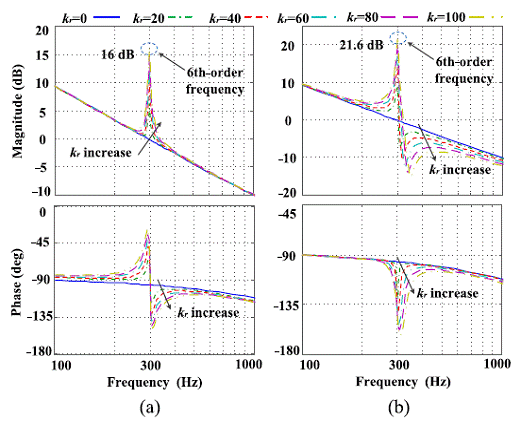
Figure 4. Bode Diagrams Of The Open-Loop Transfer Function In (28) With Different Kr : (A) Target I; (B) Target Ii.


Figure 5. The Maximum Cw Voltages Of The Two Control Targets At Different Speeds.


CONCLUSION:

The BDFM variable speed drive system based on a fractional unidirectional converter has wide application prospects for loads that require only limited range speed regulation. To solve the influence of harmonics on system, this paper studies the harmonic characteristics through a new equivalent circuit and proposes a direct harmonic control strategy. It is shown that:

1) The harmonic current contents in the machine and the grid are determined by the grid harmonic impedance and the harmonic equivalent impedance of the machine system. Calculation results agree with the experiment data;

2) The nature of the bidirectional harmonic currents control between the weak grid and the machine is changing the harmonic distribution characteristics of the BDFM driving sys- tem shown in Fig. 1, while the conventional control method can hardly realize this target;

3) The torque ripples and the harmonic currents injecting into the grid can be controlled indirectly through iph and uph;

4) The proposed control method can regulate the harmonic equivalent impedance of the machine system effectively, which commendably realizes the bidirectional harmonic cur- rent control. The equivalent circuit structure and control method pro- posed in this paper are also suitable for distorted grid with a large number of nonlinear loads. In this operation environment, a single BDFM control system is insufficient to improve the grid, which will be studied in the future.

 REFERENCES:

[1] X. Chen and X.Wang, ``Proximate standing wave feature of magnetic field and its influence on the performance of wound rotor brushless doubly- fed machine,'' IEEE Trans. Energy Convers., vol. 32, no. 1, pp. 296_308, Mar. 2017.

[2] J. Su, Y. Chen, D. Zhang, and Y. Kang, ``Stand-alone brushless doubly fed generation control system with feedforward parameters identification,'' IEEE Trans. Ind. Informat., vol. 15, no. 11, pp. 6011_6022, Nov. 2019.

[3] J. Chen, X. Wang, T. Zhao, Z. Li, M. Kong, and P. Nie, ``Application of brushless doubly-fed machine system in hydropower generation,'' in Proc. 22nd Int. Conf. Electr. Mach. Syst. (ICEMS), Harbin, China, Aug. 2019, pp. 1_4.

[4] T. D. Strous, H. Polinder, and J. A. Ferreira, ``Brushless doubly-fed induction machines for wind turbines: Developments and research challenges,'' IET Electr. Power Appl., vol. 11, no. 6, pp. 991_1000, Jul. 2017.

[5] M. Kong, X. Wang, Z. Li, and P. Nie, ``Asynchronous operation characteristics and soft-starting method for the brushless doubly-fed motor,'' IET Electr. Power Appl., vol. 11, no. 7, pp. 1276_1283, Aug. 2017.