asokatechnologies@gmail.com 09347143789/09949240245

Search This Blog

Saturday, 9 July 2022

Harmonic Voltage Control in Distributed Generation Systems Using Optimal Switching Vector Strategy

ABSTRACT:

 With increased penetration of renewable power and the nonlinear loads in the distributed generation (DG) systems, increased power quality concerns are exhibited in the active distribution networks, especially the challenges associated with the current and voltage harmonics in the system. Various conventional harmonic compensation techniques are developed for voltage-controlled DG inverters in past, majority involve either multiple proportional-integral (PI) or proportional-resonant (PR) controllers in eliminating grid current harmonics. The current controlled inverters, on the other hand, are not preferred in industrial applications, accounting to their wide variations in the switching frequency. A novel and adaptive harmonic voltage control is developed here, for voltage-controlled DG inverters, which neither uses any PI regulators nor imposes stability issues associated with nonideal implementation of infinite gains of PR controllers. Interestingly, the developed control logic can be used for DG inverters, both in grid-connected and off-grid operational modes. Furthermore, this strategy allows a network operator to use this as an additional supplement that can be enabled/disabled as per the network requirement. The control logic exploits the property of an optimal-switching-vector controller, i.e., accurate output voltage tracking. Simulations results demonstrate the effectiveness of the controller, to suppress grid current harmonics and load voltage harmonics in grid-interfaced (GI) and off-grid modes, respectively, ultimately satisfying the mandatory IEEE standard-1547. Experimental results verify the viability of the controller for practical applications.

KEYWORDS:

1.      Distributed generation (DG)

2.       Harmonics

3.      Optimal switching- vector (OSV) control and voltage source inverter (VSI)

      Power quality

SOFTWARE: MATLAB/SIMULINK

SCHEMATIC DIAGRAM:


Fig. 1. System configuration.

EXPECTED SIMULATION RESULTS:


Fig. 2. Salient internal signals of the harmonic voltage controller upon enabling the harmonic control switch (a) vpabc5, vpabc7, vpabc11, and vpabc13, (b) |vp|abc5, |vp|abc7, |vp|abc11, and |vp|abc13, (c) λpabc5, λpabc7, λpabc11, and λpabc13, and (d) vc abc5, vc abc7, vc abc11, and vc abc13.


Fig. 3. Reference voltages generated by the harmonic voltage controller.


Fig. 4. Salient internal signals of the OSV controller upon enabling the harmonic control switch (a) voαβ, ioαβ, and  vcαβ with SS1, and voαβ of future sampling instant with SS1, (b) “eα” of future sampling instant with SS1, MGPC with SS1, SS2, and SS3, and (c) MGPC with SS4, SS5, SS6, and SS0.


Fig. 5. Optimal minimization function and the corresponding switching sequences generated by the OSV controller.


Fig. 6. Performance of a single DG-VSI system in GI mode (a) without any harmonic voltage control and (b) with the presented control.

CONCLUSION:

A harmonic voltage control strategy using optimal switching vector controller has been explored for a three-phase grid connected and off-grid DG system. A minimization criterion is used in an OSV controller to achieve accurate output voltage tracking performance and flexibly control the DG output harmonic voltage. In this way, the harmonic currents entering the grid are precisely regulated in the grid-connected mode of operation. In stand-alone mode of operation, the power quality is improved by elimination of PCC voltage harmonics caused by nonlinear load in the system. The controller eliminates the usage of multiple PR controllers, PI regulators, cascaded feedback loops, or phase locked loops in the system. The simulation and Fig. 17. System performance with OSV-based harmonic control (a) vgab with iga and iLa, (b) salient internal signals of the OSV controller reference voltages corresponding to gating pulses, (c) VDC, iga, and harmonic currents absorbed by the DG, and (d) performance without any harmonic control—iLa, vgab, iga, and ioa. Fig. 18. (a) THD of vgab. (b) THD of iLa. (c) THD of iga. experimental performances are evaluated to confirm the viability of the algorithm. The employed modern DG systems increased renewables and are subject to rapidly increasing nonlinear loads, and the presented control strategy is a possible solution for voltage-controlled DG inverters. As this controller is possible to be appended in existing DG inverter controls, it can be easily enabled or disabled flexibly, as per the system operator need.

REFERENCES:

[1] D. E. Olivares et al., “Trends in microgrid control,” IEEE Trans. Smart Grid, vol. 5, no. 4, pp. 1905–1919, Jul. 2014.

[2] H. R. Baghaee, M. Mirsalim, G. B. Gharehpetian, and H. A. Talebi, “Decentralized sliding mode control of WG/PV/FC microgrids under unbalanced and nonlinear load conditions for on- and off-grid modes,” IEEE Syst. J., vol. 12, no. 4, pp. 3108–3119, Dec. 2018.

[3] IEEE Standard for Interconnection and Interoperability of Distributed Energy Resources With Associated Electric Power Systems Interfaces, IEEE Standard 1547-2018, 2018.

[4] H. R. Baghaee, M. Mirsalim, G. B. Gharehpetan, and H. A. Talebi, “Nonlinear load sharing and voltage compensation of microgrids based on harmonic power-flow calculations using radial basis function neural networks,” IEEE Syst. J., vol. 12, no. 3, pp. 2749–2759, Sep. 2018.

[5] S. Priyank, and B. Singh, “Leakage current suppression in double stage SECS enabling harmonics suppression capabilities,” IEEE Trans. Energy Conv., vol. 36, no. 1, pp. 186–196, Mar. 2021.

Grid-Forming Control for Solar PV Systems with Power Reserves

ABSTRACT:

 This paper presents a grid-forming control (GFC) scheme for two-stage photovoltaic (PV) systems that maintains power reserves by operating below the maximum power point (MPP). The PV plant in GFC mode behaves like a voltage source that supports the grid during disturbances in full or limited grid-forming mode as per the reserve availability. This is a model-free method that avoids the estimation of MPP power in real-time commonly done in the literature, which makes it simpler and more reliable. The proposed control also features an enhanced current limitation scheme that guarantees containment of the current overshoots during faults, which is not trivial in voltage-sourced GFC inverters. A thorough investigation is done, exploring various generation mixtures of synchronous machines (SM), GFC and grid-following (GFL) inverters, and all common disturbances, e.g., load change, faults and irradiance transients. The results show very favorable dynamic performance by the GFC inverters, far superior to GFL inverters and directly comparable to SMs. It is found that replacing SMs with GFC inverters may improve the frequency profile and terminal voltage during disturbances, despite losing out in the mechanical inertia and the strict inverter overcurrent limits.

KEYWORDS:

1.      Ancillary services

2.      Current limitation

3.      Grid forming control

4.      Grid support, inverter

5.      Maximum power point

6.      Power reserves

7.      Renewables integration

8.      Solar photovoltaic (PV)

SOFTWARE: MATLAB/SIMULINK

BLOCK DIAGRAM:


Fig. 1. The overall GFC scheme for a two-stage grid-connected PV plant, (a) PV system topology, (b) DC-DC

converter control and outer inverter control loop, (c) inner inverter control loops with current limitation scheme.

 EXPECTED SIMULATION RESULTS:


Fig.2. Terminal voltage and reactive power injection in the SM GFC case subject to a three-phase fault


Fig. 3. dq components and magnitude of the inverter current, and magnitude of the VSC reference voltage in the SM GFC case subject to a three-phase fault.


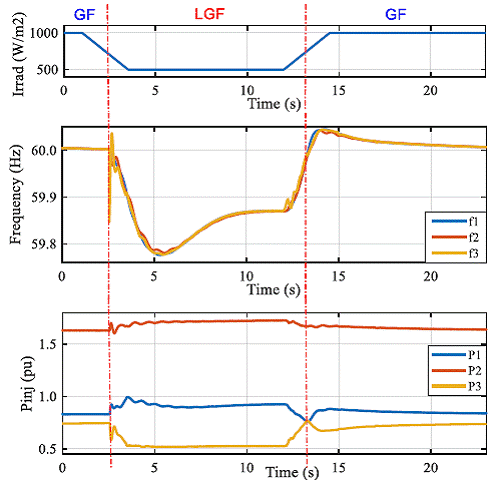
Fig. 4. Frequency and power injection in the SM GFC case subject to irradiance change.


Fig. 5. Performance of the proposed control strategy in the SM GFC case subject to irradiance change.


Fig. 6. Frequency and power injection in All GFC case subject to a load change.

Fig. 7. Voltages and reactive power injections in All GFC case subject to a three-phase fault.


Fig. 8. Frequency and power injections in SM GFL case subject to a load change.


CONCLUSION:

This paper introduces a new GFC scheme for PV systems that do not employ real-time estimation of the MPP and make optimal use of the limited power reserves. By operating in full or limited grid-forming mode, the PV plant preserves its voltage source nature and manages to assist the grid during disturbances similarly or even better than synchronous machines. The modified current saturation scheme performs smoothly, without any need for fault detection or control switching.

Replacing SMs with PV GFC results in improved frequency profile during load disturbances due to faster response from the PV plant, and comparable terminal voltage profiles during faults despite the strict inverter overcurrent limits. However, the PV GFC introduces another source of disturbances to the power system resulting from irradiance transients during cloud movement.

Inverters in GFL mode with ancillary services can support the grid during disturbances, but the contribution becomes limited as the system strength decreases. The GFC mode of inverter operation is the way forward for the renewables-rich and inverter-dominated power systems of the future.

Future work involves a complete investigation of the dynamic interactions between GFC and GFL inverters and the rest of the power system at various sizes and generation mixtures. Similarly, a methodology to determine the appropriate ratio of GFC and GFL resources would be very useful in converter-dominated power systems. Furthermore, the proposed method is designed for uniform illumination, which is the common assumption for utility-scale PV systems; an extension of the method to partial shading would improve its credibility and reliability at all possible conditions.

REFERENCES:

[1] F. Milano, F. Dörfler, G. Hug, D. J. Hill, and G. Verbič, "Foundations and challenges of low-inertia systems (Invited Paper)," Power Syst. Comp. Conf. (PSCC), Dublin, Ireland, 2018.

[2] C. Loutan, P. Klauer, S. Chowdhury, S. Hall, M. Morjaria, V. Chadliev, N. Milam, C. Milan, and V. Gevorgian, “Demonstration of essential reliability services by a 300-MW solar photovoltaic power plant,” National Renewable Energy Lab. (NREL), Golden, CO, United States, Rep. NREL/TP-5D00-67799, 2017.

[3] ENTSO-E, “Need for synthetic inertia (SI) for frequency regulation: ENTSO-E guidance document for national implementation for network codes on grid connection,” ENTSO-E, Brussels, Belgium, Tech. Guideline, Jan. 2018.

[4] J. C. Hernandez, P. G. Bueno, and F. Sanchez-Sutil, “Enhanced utility-scale photovoltaic units with frequency support functions and dynamic grid support for transmission systems,” IET Ren. Power Gen., vol. 11, no. 3, pp. 361-372, Jan. 2017.

[5] C. Guo, S. Yang, W. Liu, C. Zhao, and J. Hu, "Small-signal stability enhancement approach for VSC-HVDC system under weak AC grid conditions based on single-input single-output transfer function model," IEEE Trans. Power Del., to be published. DOI: 10.1109/TPWRD.2020.3006485.


Fuzzy Logic Control for Solar PV Fed ModularMultilevel Inverter Towards Marine Water Pumping Applications

 ABSTRACT:

This paper presents the design and implementation of Modular Multilevel Inverter (MMI) to control the Induction Motor (IM) drive using intelligent techniques towards marine water pumping applications. The proposed inverter is of eleven levels and has the ability to control the speed of an IM drive which is fed from solar photovoltaics. It is estimated that the energy consumed by pumping schemes in an onboard ship is nearly 50% of the total energy. Considering this fact, this paper investigates and validates the proposed control design with reduced complexity intended for marine water pumping system employing an induction motor (IM) drive and MMI. The analysis of inverter is carried out with Proportional-Integral (PI) and Fuzzy Logic (FL) based controllers for improving the performance. A comparative analysis has been made with respect to better robustness in terms of peak overshoot, settling time of the controller and Total Harmonic Distortion (THD) of the inverter. Simulations are undertaken in MATLAB/Simulink and the detailed experimental implementation is conducted with Field Programmable Gate Array (FPGA). The results thus obtained are utilized to analyze the controller performance, improved inverter output voltage, reliable induction motor speed control and power quality improvement by reduction of harmonics. The novelty of the proposed control scheme is the design and integration of MMI, IM drive and intelligent controller exclusively for marine water pumping applications.

KEYWORDS:

1.      Field programmable gate array

2.      Fuzzy logic controller

3.      Induction motor drive

4.      Modular multilevel inverter

5.      Proportional-integral

6.      Total harmonic distortion

SOFTWARE: MATLAB/SIMULINK

SCHEMATIC DIAGRAM:


Figure 1. Schematic Diagram Of The Proposed 11-Level Inverter.Aq

 EXPECTED SIMULATION RESULTS:


Figure 2. Speed Response Of Pi Controller At 1000 Rpm.


Figure 3. Speed Response Of Flc At 1000 Rpm.


Figure 4. Harmonic Analysis With Pi Controller.


Figure 5. Harmonic Analysis With Fl Controller.


Figure 6. Output Voltage Waveform Of An 11 Level Inverter.


CONCLUSION:

The relevance of the proposed work is to provide high quality of input power to the inverter drive pertaining to marine water pumping applications. A solar PV fed MMI for speed control of induction motor drive has been examined at steady state and dynamic behaviors to investigate its suitability for water pumping system intended for the marine applications. The solar PV array is connected with the proposed inverter when is then fed to an induction motor. The motor speed is sensed and feedback is given to the controller for generating optimal PWM pulses for the inverter switches. The motor is started gradually and the speed is increased to achieve reference speed with aid of PI and FL based controllers. The performance of PI and FL controllers for a feasible operation is verified and results are compared in both simulation and experiment. The results ensure that the FL based controller provides fast settling time and reduced harmonics when compared with the PI controller. The main impact of the proposed control scheme is to reduce the steady-state error of the induction motor speed control and deteriorate harmonics at the output voltage of modular multilevel inverter. On considering the number of components required for the proposed MMI, the Table 3 illustrates the comparative analysis on the number of semiconductor switches required for the design of MMI along with those inverters available in the literature.

The source, converter, load, controller and grid are the major components of a DC microgrid. A microgrid is normally referred as a standalone autonomous system to generate power by the community and for the community regions. In the proposed system, the entire component cited for DC microgrid is present and performs its function effectively. The appropriate estimation of power generated and power used is the future scope.

REFERENCES:

[1] H. Lan, Y. Bai, S.Wen, D. C. Yu, Y.-Y. Hong, J. Dai, and P. Cheng, ``Modeling and stability analysis of hybrid PV/diesel/ESS in ship power system,'' Inventions, vol. 1, no. 5, pp. 1_16, 2016, doi: 10.3390/inventions1010005.

[2] S. G. Jayasinghe, L. Meegahapola, N. Fernando, Z. Jin, and J. M. Guerrero, ``Review of ship microgrids: System architectures, storage technologies and power quality aspects,'' Inventions, vol. 2, no. 4, pp. 1_19, 2017, doi: 10.3390/inventions2010004.

[3] R. Kumar and B. Singh, ``Single stage solar PV fed brushless DC motor driven water pump,'' IEEE J. Emerg. Sel. Topics Power Electron., vol. 5, no. 3, pp. 1337_1385, Sep. 2017, doi: 10.1109/JESTPE.2017.2699918.

[4] S. Shukla and B. Singh, ``Single-stage PV array fed speed sensorless vector control of induction motor drive for water pumping,'' IEEE Trans. Ind. Appl., vol. 54, no. 4, pp. 3575_3585, Jul./Aug. 2018, doi: 10.1109/TIA.2018.2810263.

[5] C.-L. Su, W.-L. Chung, and K.-T. Yu, ``An energy-savings evaluation method for variable-frequency-drive applications on ship central cooling systems,'' IEEE Trans. Ind. Appl., vol. 50, no. 2, pp. 1286_1297, Mar./Apr. 2014, doi: 10.1109/TIA.2013.2271991.

Friday, 8 July 2022

Fractional Order Notch Filter for Grid-Connected Solar PV System with Power Quality Improvement

 ABSTRACT:

 This paper deals with the development of fractional order notch filter (FONF) for a grid-connected solar photovoltaic (PV) system. The developed FONF control approach is used to estimate fundamental active constituents from the distorted load currents and hence gating pulses for operating voltage source converter (VSC) are used in the PV system. This control approach for the grid-connected solar PV system is designed to achieve several purposes such as feeding active power demand of load/grid and counter current related power quality issues at common connecting point. The power quality issues taken into consideration are harmonics distortion, reactive power burden on the system and unbalancing of connected loads. The FONF based control proposes a modified structure of an integer order notch filter. The integer order filters have limitation due to fixed integrator and differentiator term. In FONF, the power of integrator used in a notch filter, can be modified according to the application required for obtaining accurate response of the system. A prototype of the grid-connected solar PV system is developed in the laboratory using IGBTs based VSC and dSPACE MicroLabBox (DS-1202) to demonstrate the behaviour of the FONF based control. Simulation and experimental results are obtained for steady state and unbalanced loads with variation in solar irradiance. The harmonic distortions in the system are observed as per the IEEE-519 standard.

 KEYWORDS:

1.      Solar photovoltaic generation

2.      Fractional order control

3.      Notch filter

4.      Harmonics

5.      Power quality

SOFTWARE: MATLAB/SIMULINK

SCHEMATIC DIAGRAM:


Fig. 1 System configuration of grid connected solar PV system.

EXPECTED SIMULATION RESULTS:


Fig. 2 Bode plot comparison of IONF (α=1, β=1, ξ=0.1 and α=1, β=1, ξ=1) and FONF (α=1.2, β=0.8, ξ=0.5) with different values of fractional parameters.


Fig. 3 Comparative performance of IONF and FONF in converging active weight component.


Fig. 4 Convergence of fundamental active components using FONF, NLMS and NLMF under (a) steady state and (b) unbalanced loading conditions.


Fig. 5 Harmonic spectra of (a) grid current iga using FONF (b) grid current iga using NLMS (c) grid current iga using NLMF (d) load current ila.


Fig. 6 Harmonic spectrum of grid current with different frequency components using FONF controller.


Fig. 7 Harmonic spectrum under nonlinear load with R-C parallel branch using FONF controller (a) grid current, iga (b) load current, ila.


CONCLUSION:

 A three-phase grid connected solar photovoltaic system with FONF based control has been proposed in this work. The FONF control has been designed to accomplish twin functions of the grid-connected PV system viz. delivering active power to the load/grid and alleviating current related power quality issues at PCC. Numerous power quality issues such as harmonics distortion in the grid current, reactive power demand of the load and unbalancing load currents have been solved by the developed control system. The FONF control has been found suitable in terms of its flexibility to alter power of integrator used in the notch filter and asymmetrical gain response curve, which is not possible in case of integer order notch filter. It has been observed from the Bode plot that sharpness of developed FONF does not alter by increasing the value of damping ratio once fractional gains are appropriately decided. Moreover, this control presents fast response when compared with integer order notch filter. Performances of FONF controller have been confirmed at steady state and unbalanced load along with variation in solar irradiance considered. Experimental results demonstrate performance of FONF controller in maintaining 3.2% THD in the grid current, which is in accordance with the IEEE-519 standard for the grid interfaced PV system.

REFERENCES:

[1] A. Reinders, P. Verlinden, W. Sark and A. Freundlich, Photovoltaic Solar Energy: From Fundamentals to Applications, Hoboken, NJ, USA, Wiley, 2017.

[2] R. Precup, T. Kamal, S. Z. Hassan, Solar Photovoltaic Power Plants: Advanced Control and Optimization Techniques, Gateway East Singapore, Springer, 2019.

[3] M. K. Hairat, S. Ghosh, “100GW solar power in India by 2022 – A critical review”, Rene. Sustain. Ener. Rev., vol. 73, pp.1041-1050, 2017.

[4] N. Priyadarshi, S. Padmanaban, P. K. Maroti and A. Sharma, “An extensive practical investigation of FPSO-based MPPT for grid integrated PV system under variable operating conditions with anti-islanding protection,” IEEE Sys. Journal, vol. 13, no. 2, pp. 1861-1871, June 2019.

[5] N. Mukundan C. M., Y. Singh, S. Naqvi, B. Singh and J. Pychadathil, “Multi-objective solar power conversion system with MGI control for grid integration at adverse operating conditions,” IEEE Trans. Sust. Energy, vol. 11, no. 4, pp. 2901-2910, 2020.